V6 / Value — Commissioning Manager
Shankar carries the phase where projects succeed or failCommissioning, unbroken.
The L1 to L6 sequence — sequenced the way commissioning actually runs. OFCI readiness: equipment ordered, manufactured, FAT-witnessed, shipped, received, installed, commissioned, accepted. Witness diary: locked, conflict-aware, 14 days ahead. Chain of custody: one unbroken thread from factory to handover. Vendor attendance, snag routing, acceptance gates. One screen. The record Donnelly trusts and Krupa accepts.
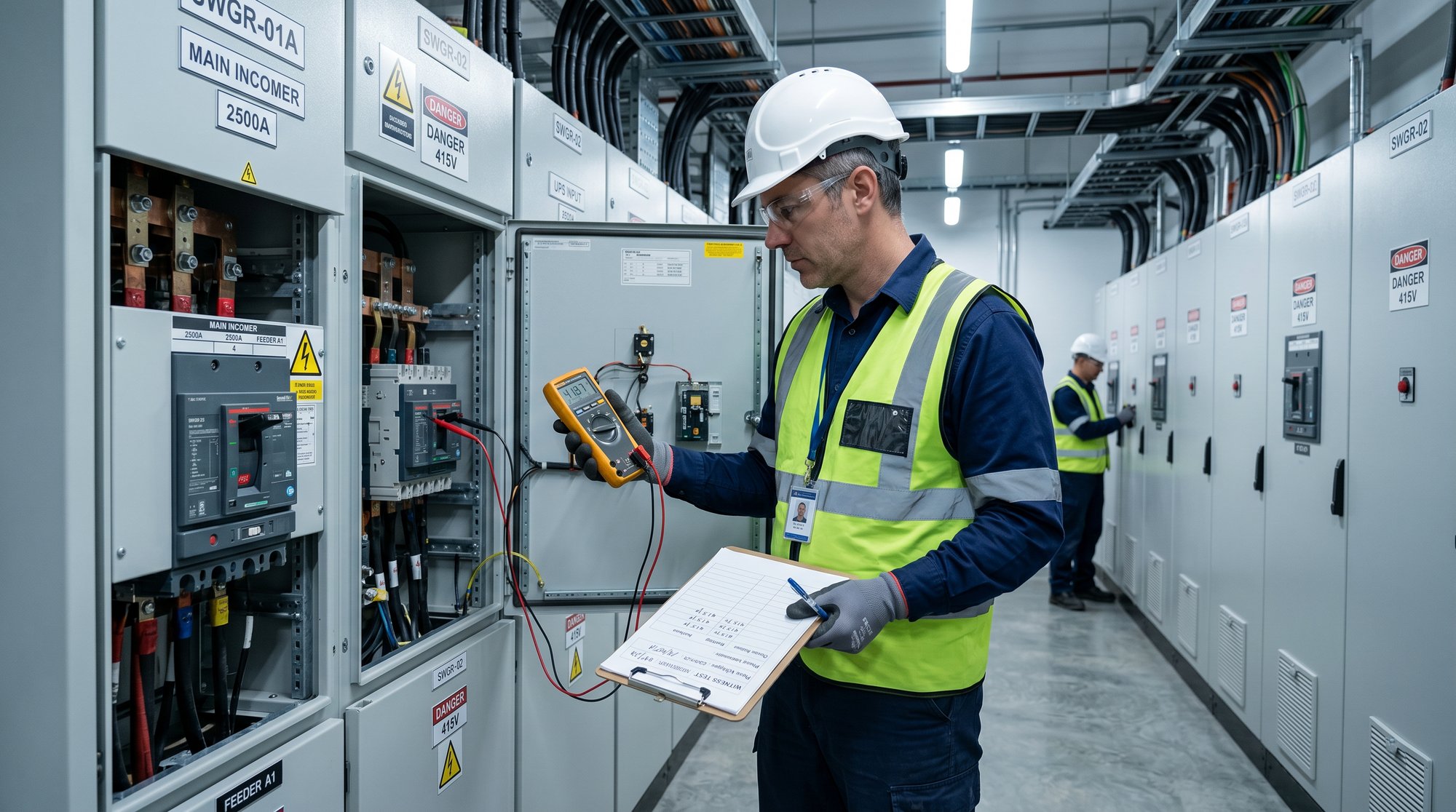
Shankar opens the Cx Spine at 07:10 and sees exactly what's ready, what's blocked, and what needs witness today.
Shankar has lost enough Saturdays to commissioning to know the difference between "on track" and "on paper." Loadbearer makes those two things the same thing — by surfacing the OFCI chain, the witness slots, the vendor confirmations, and the snag closures in one record that Donnelly audits and Krupa accepts without asking.
The commissioning triangle
Commissioning runs in a triangle. Loadbearer makes the triangle work.
There are three parties to every commissioning gate on Cranebank. They have different roles, different accountabilities, and different views of the same record. Loadbearer wires them together — not by collapsing their independence, but by making the shared record visible to all three simultaneously.
Shankar · CxM · Marauder Construction
Runs the commissioning programme. Owns the L1 to L6 sequence. Manages OFCI readiness, vendor attendance, test prerequisites, snag routing. Reports to Halloran for programme and to Donnelly for witness scheduling. Signs at his level — test readiness, prerequisites cleared, OFCI received.
Donnelly · CxA · Sentinel
Independent commissioning authority, retained by the client. Witnesses tests at L3, L4, L5 and IST. Signs the impartial line — not readiness, but the result. "Donnelly trusts the record because it is the record — not a reconstruction." His record is structurally independent of Marauder's, and visibly so.
Krupa · CIO · Phoenix Digital
Acceptance authority. Receives the client portal feed automatically — no reconstruction, no Friday email. "Krupa sees acceptance readiness the moment it is real — not the week after." She accepts at her level; she does not chase. Her portal view is independent of both Marauder and Sentinel.
The OFCI channel — owner-furnished, contractor-installed
On a data hall, the OFCI list is the project. Loadbearer treats it that way.
Owner-Furnished, Contractor-Installed equipment is the schedule. Switchgear, UPS, PDUs, busways, chillers — procured by Phoenix Digital, handed to Marauder to install, commission and integrate. Late OFCI moves the IST. Late IST moves handover. Loadbearer puts OFCI at the centre, not the margin.
What Loadbearer eliminates
- The OFCI tracker spreadsheet that one person owns and emails round on Fridays.
- The "where's the busway?" call that happens every Friday afternoon.
- The vendor attendance email chain across Schneider, Vertiv, Trane and Eaton simultaneously.
- The "did we accept that delivery?" four-day argument when the condition report is missing.
- The custody transfer that nobody documented — contractor says it was damaged at delivery, client says it left the factory intact.
- The IST slippage that surprises everyone six weeks before handover because one OFCI item was quietly running late for three months.
What Loadbearer surfaces
- Free-issue dates against latest programme — green, amber, red, automatically, without a phone call.
- Vendor attendance: vendor named, commissioning engineer named, dates locked, confirmation live on the diary.
- Equipment readiness chain per item: ordered → manufactured → FAT-witnessed → shipped → received → installed → SAT-witnessed → commissioned → witnessed → accepted.
- Dependencies between each OFCI item and the commissioning levels that need it — L3, L4, L5, IST — visible before the dependency bites.
- The OFCI-driven critical path: which late piece of kit actually moves handover, not which one is merely late.
- Custody at each transition: who took it, when, in what condition, with whose signature.
Cranebank OFCI scope · illustrative
- Switchgear — 18 sets · OFCI from Schneider · 6 received, 4 installed, 2 commissioned
- PDUs — 162 units · OFCI from Vertiv · 54 received, 18 installed
- Chillers — 12 units · OFCI from Trane · 8 received, 4 installed, 0 commissioned
- Busways — 4.2 km · OFCI from Eaton · 2.1 km received, 1.4 km installed
- UPS — 9 systems · OFCI from Schneider · 4 received, 2 installed
- Server racks — 3,240 units · client-installed · scheduled post-acceptance
Shankar doesn't manage commissioning. He manages OFCI. Everything else flows from it.
The Cx Spine · ten channels, one record
The commissioning picture, in the sequence it actually runs.
The Cx Spine opens at 07:10 in the order commissioning actually moves. Top-of-screen: the sequence — what is ready, what is blocked, what is at gate today. Mid-screen: the operational levers — OFCI status, vendor attendance, the witness diary. Bottom-of-screen: the record — snags, acceptance gates, the CxA-facing chain, and Krupa's portal feed. Every cell is a live query against the same record. Reconciled the moment it changes; defensible to Donnelly the moment it is questioned.
L1 to L6 sequence
Sequenced the way commissioning actually runs — not the way a spreadsheet is laid out. Every test, every prerequisite, every gate. L1 pre-energisation checks through L6 integrated system test and acceptance. Progress by pod, by hall, by storey. What is ready, what is blocked, what is waiting for witness.
Witness diary
Locked, conflict-aware, 14 days visible, cross-package clashes surfaced 28 days ahead. Cooling-to-electrical clashes, UPS witness slots against CRAC pre-commissioning, BMS integration against LV commissioning. The clash that cost 31 days on the last hall is visible 28 days before it bites on this one.
Chain of custody
Every test, every witness, every re-test — one unbroken chain from the manufacturer's factory acceptance test through delivery, pre-commissioning, site witness, and client acceptance. "If it isn't witnessed, it didn't happen." The chain is one query, answered in a second, exportable for Donnelly on the spot.
Equipment readiness
By item, by type, by hall. FAT date and result, delivery date and condition, SAT date and result, IST date and result, acceptance date. Every OFCI item and every contractor-supplied item in a single readiness view. Shankar sees what is ready for witness today without asking the sub or the vendor.
OFCI — owner-furnished, contractor-installed
Its own channel because of its weight. Free-issue dates against latest programme — green, amber, red. Equipment readiness chain per item. The OFCI-driven critical path. Custody at each transition. Switchgear, UPS, PDUs, busways, chillers — each with its own readiness thread. See the detailed OFCI section above.
Vendor attendance
Schneider commissioning engineer, Vertiv field specialist, Trane controls engineer, Eaton power quality team — named, dated, confirmed, with attendance commitments live on the witness diary. The vendor who fails to attend without notice is on the record. The slot is held only when the named engineer is confirmed.
Snags
Captured at the witness moment — not on a paper sheet, not retyped on Monday. Routed immediately to the responsible package, with a target close-out date driven by the IST gate. Every open snag tied to a specific test instance, a specific re-test slot, and a named owner. IST-blocking snags surfaced separately.
Acceptance readiness
By gate, by hall, by the date the contract requires it. L3, L4, L5, IST — each gate with a one-click evidence pack: every test, every result, every witness, every sign-off. "Acceptance day is just another day. The evidence has been there for weeks." The gate is not a scramble; it is a confirmation.
CxA-facing record
Independent, exportable, and structurally untouchable by Marauder. Donnelly's record is separate from the contractor's record — separate sign-off rights, separate witness register, exportable on its own. The contractor cannot edit a witness outcome. "Donnelly's record is independent of Marauder's record, and visibly so."
Client portal feed
Krupa's view of acceptance readiness, fed automatically from the live record. No reconstruction, no Friday email, no phone call asking what the status is. "Acceptance becomes confirmation, not discovery." Krupa sees her own kit, her own gates, her own hall-by-hall progress — the moment it is real.
At your fingertips, every commissioning day
The commissioning picture Shankar never had to reconstruct.
Lessons learned · forensic, not decorative
The commissioning slip that broke the last hall is the one that won't break this one.
-
CX-007
OFCI free-issue dates that slip more than 14 days correlate 0.81 with IST slippage of equal or greater magnitude across the last six halls — because the dependency is direct and the buffer is already consumed.
OFCI dates with more than 7 days of movement now auto-flag the IST gate before the slip is locked in — not after. Halloran sees a programme impact, Coughlan sees a commercial event, and Shankar has the EW drafted before the vendor has answered the phone.
-
CX-013
Vendor attendance failures at witness moments — where the named commissioning engineer did not attend — caused 19 re-test events across the last three halls, adding an average of 4.1 days per re-test to the commissioning programme.
Vendor attendance is confirmed by a named engineer, not by a company email. Attendance commitments are in the diary 14 days ahead; non-confirmation at 48 hours auto-escalates to the vendor's commercial lead and to Shankar. The named engineer either confirms or is replaced.
-
CX-019
IST failures driven by snags that were visible at L4 witness but not formally raised accounted for 67% of IST gate delays across eight halls — the snag existed, but nobody owned it, so nobody closed it.
Every item observed at a witness moment that does not achieve the test result generates a snag automatically — named owner, close-out target derived from the next gate date, re-test slot in the diary within 72 hours. No floating observations; no verbal "we'll sort it before IST."
-
CX-025
Commissioning binders assembled by hand at handover contained an average of 6.3 inconsistencies per hall between the contractor's record and the CxA's record — a discrepancy that took an average of 11 days to resolve before Krupa could accept.
The contractor record and the CxA record are reconciled live — not at handover. Structural segregation means differences surface at the test moment, not at the binder assembly. The 11-day resolution period on the last hall is the 0-day resolution on this one.
What stops happening
- The Cx tracker spreadsheet that one person owns and emails round on Fridays.
- The "is L3 done?" meeting — because L3 status is on the screen and has been for a week.
- The 2,000-page paper commissioning binder that nobody can navigate and one person spent three weeks assembling.
- L4 and L5 evidence hunts at handover — the evidence was there when the test happened.
- Witness coordination chase-ups across Schneider, Vertiv, Trane and Eaton simultaneously.
- Defect re-test loops that nobody can see the end of because the snag has no owner and no close-out target.
- Scope-versus-status confusion between Apex Mechanical, Halloran Electrical and the OFCI vendors at the same gate.
- The Saturday night mental walk-through of whether L4 will be ready Monday — because the answer is on the screen at 22:00 Friday and Shankar can stop walking through it.
The signed loop
Three humans sign at three levels. The system holds the thread between them.
Shankar signs readiness — that the prerequisites are cleared, the OFCI is installed, the test can proceed. Donnelly signs the result — that the test was witnessed, that the outcome is what the record says it is, that the snag list is complete. Krupa signs acceptance — that the system is ready to receive her equipment and her data. Three different signatures. Three different accountabilities. One record that connects them.
The system never accepts a test for the client. The system never witnesses a result for the CxA. The system never clears a prerequisite for the CxM. Loadbearer drafts; Shankar reads, judges, signs. Principle 4. Principle 7.
"Commissioning is where projects fail. Loadbearer keeps the thread unbroken."
— Shankar · CxM · Marauder Construction (fictional)
"If it isn't witnessed, it didn't happen. Loadbearer makes sure it happens — and that everyone sees it."
— Shankar · CxM · Marauder Construction (fictional)
Adjacent
The Cx Spine connects upward to Halloran, outward to Donnelly, and forward to Krupa.
Shankar's record drives the IST gate on Halloran's programme dashboard, feeds the independent chain Donnelly witnesses, and populates the acceptance view Krupa reads in her portal. One record, four authorised views, no reconciliation, no Friday email.